
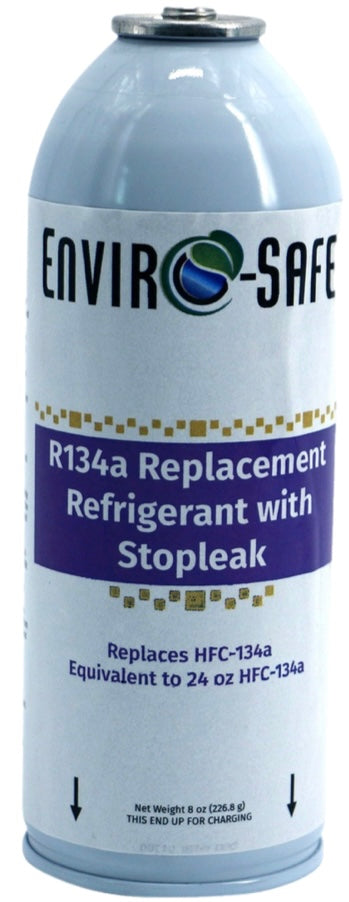
R134a Replacement w/Stop Leak in 21oz Equivalent Cans
Manufactured by Enviro-Safe Refrigerants, Inc.
Enviro-Safe® R134a Replacement with Stop Leak (21 oz. Equivalent Can)
✅ Seals Leaks & Restores Cold Air
Recharge your A/C system while sealing small leaks from O-rings and rubber components. Enviro-Safe® R134a Replacement with Stop Leak has been trusted for over 29 years to bring back that original, icy-cold performance.
Key Benefits
-
1 Can = 21+ oz. of R134a – cools with less product required
-
Stop Leak Formula – seals leaks in O-rings and gaskets
-
Lower Head Pressure – extends compressor life and improves efficiency
-
Compatible with most refrigerant oils and R134a systems (including pre-1994 vehicles that meet EPA Snap regulations)
-
Non-ozone depleting & non-global warming
-
Made in the USA with pharmaceutical-grade, computer-blended hydrocarbons
-
No foul odor – unlike other brands, Enviro-Safe is highly refined and sulfur-free
Why Enviro-Safe?
Other brands cut corners with unrefined hydrocarbons that create a strong sulfur or “rotten egg” smell. Enviro-Safe is different:
-
Pharmaceutical-grade & highly refined
-
Blended to within 0.25% accuracy by a major U.S. petrochemical supplier
-
Consistent quality every time you use it
-
Backed by a guarantee not to harm compressors or mechanical components when used as directed
Enviro-Safe refrigerants meet international standards including ISO 5149, BS 4434-1995, AS/NZS 1677, and ASHRAE 5149.
Important Notes ⚠️
-
Do NOT use in ammonia systems
-
Do NOT pull a vacuum when charging with this product (cans are not designed for vacuum use)
-
For larger or dual A/C systems (SUVs, vans, Suburbans), use Enviro-Safe Industrial R134a Replacement instead
-
Flammable – keep away from sparks, open flame, or smoking materials
-
Cannot ship to Alaska, Hawaii, or overseas (except pallet quantities)
Directions (Summary)
-
Repair all leaks before charging.
-
Recover existing refrigerant.
-
With compressor OFF, connect gauges/hoses.
-
Invert can and charge into the low-pressure side.
-
Test for leaks with dye, UV glasses, electronic tester, or soap bubbles.
-
Turn compressor ON, add refrigerant until pressures match manufacturer specs.
-
Do NOT exceed 60 psi on the low-pressure port.
-
Disconnect gauges and cap service ports.
(Full instructions printed on the can — follow manufacturer guidelines closely.)
